Let’s Talk About Money
December 4, 2025
We The Free is successfully mobilizing a global community of passionate vegans; proud activists who dedicate their time and effort to a cause because of a shared sense of purpose, belonging, and vision. As WTF experiences rapid growth in the number of teams and organizers worldwide, and as our interpersonal connections with that network inevitably become more distant and online, it’s more important than ever for us to clearly and transparently communicate our strategy, our decisions, and the reasons behind both in an accessible way. This article is one of a series aiming to pierce the veil and demystify the inner workings of We The Free. We hope this helps you feel more connected to us.
Getting Funded
In the founding days of We The Free, everybody involved volunteered our time as a project of passion. Personally, I worked as a manager for a charity in the social care sector in a job that was technically meant to be a 9–5, but usually ended up being 60+ hour weeks due to staff shortages, high industry turnover, and the responsibility associated with management. Still, since becoming an animal activist just a couple of years earlier, I spent an extraordinary amount of time late at night thinking, “How can I make the biggest difference for animals?” Just like my peers at the time, I believed in the shared vision for We The Free enough that I was willing to volunteer every waking moment of my spare time to achieve it.
Not only was every weekend spent supporting events for our first pilot teams in the UK, but every evening was spent writing policies, guidance, training documents, and contributing to website design, the strategic plan, and more. And I couldn’t have been happier.
At the time, there had been a series of controversies within the movement about financial mismanagement, a lack of transparency, and in some cases, fraud. This contributed to a feeling of unease around money, both in the movement and within our team, to the extent that money became a dirty word.
We all agreed that if our organization ever received funding, we wanted to do things differently. We wanted to be transparent with donors, and we never wanted to lose sight of the idea that we have a solemn duty to ensure every cent we receive is used in the most effective way we know, in service of our mission.
Want to learn more about the WTF “Origin Story”? Click here.
Find out more about WTF’s “Theory of Change” here.
When we applied for and received our first ever grant, it was because We The Free had grown to the point where we knew it was now or never. We deeply believe that creating WTF teams worldwide is both necessary and impactful. However, it was becoming increasingly difficult to effectively support our teams and scale operations to create more of them.
When I received the email telling me we had been approved for a small seed funding grant by a private foundation to help launch the organization, I jumped around my home shouting with joy. It was going to happen. We were going to officially launch this new organization, and I could focus all of my time and energy on it, not just what was left of me after coming home exhausted from my regular job. At the same time, I felt a deep sense of gratitude that people believed in what we had built, a renewed sense of purpose, and a strong awareness of how privileged I was (and still am) to be able to work in the movement.
“Working in the Movement”
That’s a strange phrase to use, because we never saw animal rights as a career. Personally, I had already declined large pay rises when I decided to work exclusively for mission-driven registered charities in the social care sector rather than private care companies that regularly sent me job offers on LinkedIn. Then I took a large pay cut when I left my career to help launch WTF. Rather than feeling like a job or a career, the team saw it as taking a living allowance so that we wouldn’t need traditional employment. After all, our sincere wish is that our activism is so effective that We The Free no longer needs to exist because we achieve our vision.
So how did things change once we received funding? Despite the fact that I was making sacrifices (my previous career that I loved, and a higher salary), I felt a sense of shame every time I spoke to the organizers I had been volunteering alongside for the past year. I found myself constantly justifying why it was necessary for me to take a salary, and even sharing how little I was being paid out of fear of creating a rift between myself and unpaid fellow activists.
“As a younger organizer, the main reason I favored low salaries was to avoid widening the gulf between paid and unpaid members of an organization. If salaries are low, then taking a job in the movement will be seen as a sacrifice rather than a privilege, and volunteers won’t wonder why they’re showing up for free when the person next to them is being paid. There’s also another, simpler reason: low salaries are cheaper, and mean we can get more done with our very limited budget.” - Aidan Kankyoku, Sandcastles Blog
Mark and Paul Engler, in This Is An Uprising, argue that many historically powerful social movements have had very low budgets and minimal paid staff, relying on volunteers and sacrifice. Of course, there are opposing viewpoints. Critics point out that the industries we are fighting against pay huge salaries to attract world-class talent, and that to be effective, we also need world-class talent. It becomes a kind of public opinion arms race.
It’s true that our movement is often a revolving door of people entering with starry eyes and bright ideas, only to burn out and leave after two years. It’s also true that for certain technical roles, such as full-stack web developers, it’s incredibly difficult to find people capable of earning $200,000 a year plus benefits who are willing to work for minimum wage, no matter how noble the mission.
When asked my opinion on this debate, I half joked that even though the WTF team takes much lower-than-average salaries, I just needed to make sure I had enough cash left in a few years to pay for the therapy I’m going to need after all the “messed up crap I’ve seen” since becoming an activist. Both the animal suffering I had witnessed and the emotional burden of so much infighting had taken a toll. Since then, the biggest change has been seeing our paid team grow to around twenty people, mostly part-time, and witnessing both their sacrifices and their impact. I feel a duty not to exploit their kindness and to invest in their sustainability. It’s the right thing to do, and it’s cost effective. Losing people to burnout after only two years is expensive, especially when you factor in recruitment and retraining.
I have also noticed a consistent pattern with our new hires. WTF heavily prioritizes giving paid positions to people who have already volunteered with us. More than 80 percent of our roles go to people with a history of volunteering, with the exceptions being technical roles we could not fill from within the volunteer base. And in almost every example of a volunteer transitioning into a paid position, they have reported feeling shame, undeserving, or not good enough during their first month.
Imposter Syndrome is the persistent inability to believe that one's success is deserved or has been legitimately achieved as a result of one's own efforts or skills. - Oxford Dictionary
For the record, those volunteers who step into paid positions almost always do amazing once they overcome this initial feeling. We continue to take humble salaries well below sector averages while trying to strike the balance between cost effectiveness and not being exploitative. We also keep our commitment to transparency with major donors, who have access to detailed financial reporting and even every receipt if they want it. Recently, we hired a bookkeeper to help us improve transparency further by producing financial reports we can share publicly on the transparency section of our site.
The State of Funding in our Movement
Whilst money might be a dirty word in our movement, it is unfortunately essential. One of the pieces of feedback we occasionally receive from donors who have heavily supported We The Free, is that they’re surprised by how much we manage to achieve with so little - and while it feels great to receive a compliment on how frugal and cost-effective we are, it is just a fact that hiring people is expensive. For the vast majority of non-profit organisations in the movement, salary costs represent by far the largest piece of the pie in their annual expenses; not because they are greedy and pay excessive salaries, but because even minimum wage is a lot of money when it’s a recurring annual expense. It can be tempting to look at a $30,000 salary and think, “Imagine the good that could be done by giving this to an animal sanctuary.” I think that way too. It’s one of the reasons why we must be as impactful as possible with what we have. The opportunity cost is real. On top of that, there are many other costs involved in running an impactful organization: web development, legal support, payroll services, insurance, and more.
Because of the discomfort around money, we are often bad at asking for it. Most charitable donations worldwide go to human issues. Around 3 percent goes to animal causes. Of that, most goes to pet charities, 2 percent to animals in testing, and about 3 percent to farmed animals. The entire farmed animal protection movement has a combined annual budget of around 300 million dollars. It sounds like a lot, but the climate movement receives over 10 billion each year.
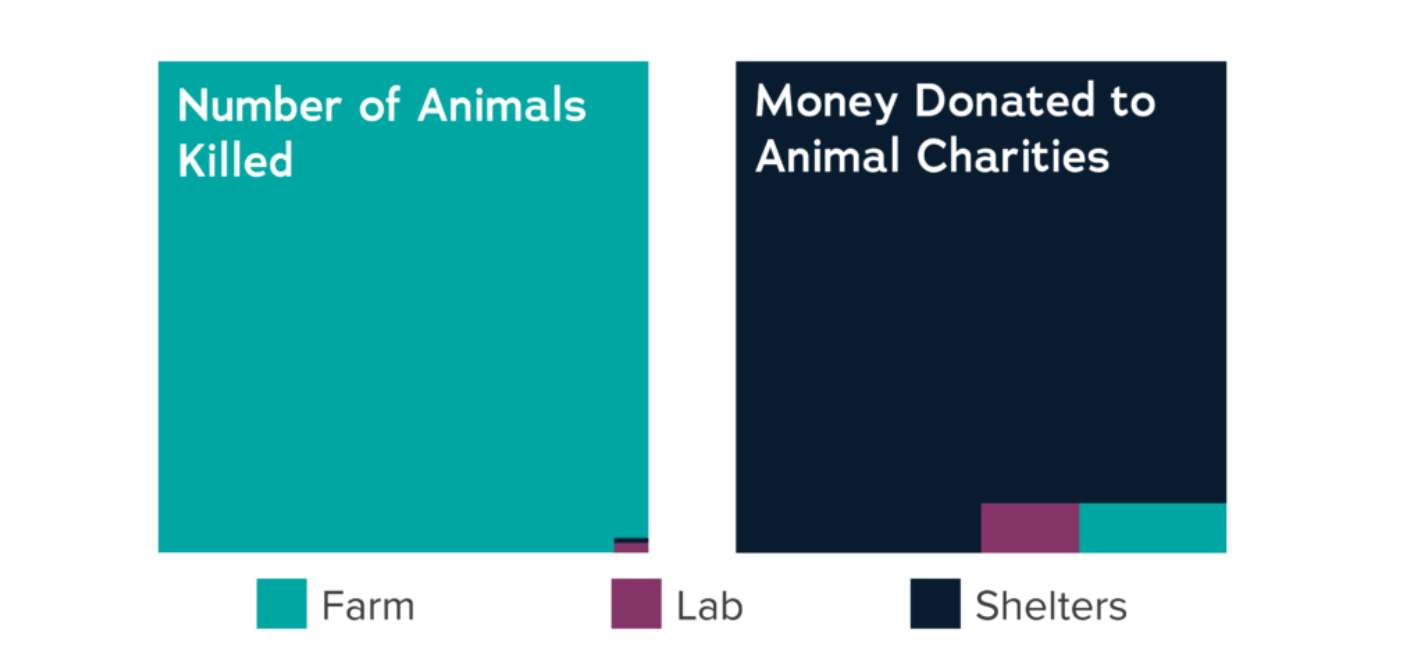
(source: Animal Charity Evaluators).
We The Free, along with other organizations in the movement, get the vast majority of our funding by applying to wealthy mission-aligned grant-making organizations who want to see a vegan world.
These grant-making organizations are utterly amazing; they are funded by a handful of ultra wealthy people who choose to use their resources to create a better future for animals rather than in self-indulgent hedonistic pursuits. The questions that keep them up at night are the same ones that plague us: how can we use our resources to make the biggest difference for animals? How can we shift the needle? What different interventions work best, and what barriers need to be overcome? They, like us, study the research, look at datasets, glean insights from other justice movements. I recently learned something interesting about one of the grant-makers which has supported We The Free for several years now - more than a decade ago, they actually funded the documentary that led to me deciding to go vegan.
My gratitude is enormous. And yet, it still isn’t enough. The industries we fight against use their resources to shape public opinion. They hire people like “Dr Evil” Rick Berman to undermine confidence in animal rights groups so effectively that years later activists still repeat misinformation his campaigns produced.
It’s also not sustainable for the movement to rely so heavily on a handful of wealthy donors. If even one of them stopped operating tomorrow, many impactful organizations would collapse.
Fundraising is an essential skill, but many of us in the grassroots aren’t prioritizing this skill because it doesn’t feel grassroots… but that couldn’t be further from the truth: powerbuilding has always been a part of grassroots success. Most major social justice movements - from labor rights and abolition to women’s suffrage, civil rights, and anti-colonial struggles - have been largely powered and financed by working-class people rather than by elites or corporate backers. These movements often arose in response to economic exploitation and political exclusion, so participants couldn’t rely on wealthy patrons to fund their liberation. Instead, they self-organized and funded efforts through membership dues, community fundraising, mutual aid, and grassroots organizing. If we want to succeed, we need to learn from this and build financial independence instead of relying on handouts.
Moving forward, we will source professional-level grassroots fundraising training for activists. We will work on becoming better at asking for money and prioritizing small, regular monthly donations. We will continue supporting local fundraising through donation-matching schemes. And we will maintain transparency while building a positive and hopeful fundraising culture, starting with WTF paid team members setting up our own monthly donations.
Looking Back
When I think back to those late nights sitting up wondering how I could make the biggest difference for animals, it was easy to imagine the impact of hosting thousands of events. I never imagined I’d end up thinking so much about salaries, funding structures, and the awkward feelings that come with them. But maybe that’s part of growing a movement. We don’t get to choose only the inspiring parts. We also have to face the uncomfortable things honestly, together.
I still don’t pretend to have all the answers. I’m learning as I go, just like everyone else in this community. What I do know is that we’re trying to build something real, something transparent, and something that respects the people who give their time and energy to this cause. If being open about money helps us do that, then I think it’s worth every uncomfortable moment.
So if you’ve made it this far, thank you. Thank you for caring enough to read this, for showing up in whatever way you do, paid or unpaid. Thank you for being part of this messy, determined, hopeful movement. We’re figuring it out together, and I’m grateful to be doing that with you.
